|
|
 |
The following are four basic parameters that run through the competition’s "theme" as defined in the introductory brochure:
a) density and mobility
b) room for local specificities
c) regard for the tropical climate
d) facilitating homeownership
Our problematic is best summarised as a response to the four variables at hand.
a) density and mobility
The europandom documentation, as well as the experts’ tables rondes held in Paris last June, largely present periurban sprawl as an ugly epidemic to be stemmed. Our working hypothesis was that it could equally be considered an historical phenomenon in its own right.
Much as the criteria employed in the definition of the Ravine Blanche problematic -e.g. "overall coherence", or "historical identity" - might be regarded as quasiobjective standards for urban quality, they also refer to a model which is historically specific, to say the least. This urban model, regardless of its actual merits, is becoming increasingly difficult to implement. More importantly, its persistence as an ideal prevents any useful revaluation of emergent urban phenomena, which are presently referred to only as lack (of quality, of history, of character) - as the europandom brochure itself demonstrates.
Do outdoor spaces need to be socially engineered, aestheticized, administered and sanitized in order to be valuable and deserving?
Even if one presumes to have found the right aesthetic and moral norms to satisfy every genuine citizen, how realistic is the idea (especially in the dom) that neither the usage and occupation of that space, nor the values that produced it will change through time?
In the same vein:
Does a sincere investment in, say, efficient public transport for the Ravine Blanche necessitate the wisdom and foresight of architects and urban planners? Is the modernisation of a bus network really such a mystery? Again - only if it hopes to be a definitive, timeless solution in a stable environment.
There must be better suggestions than the plan, or the promenade. Historically, the latter always attempted to inscribe a classical lisibility within the city space, not unlike the Public Monument, which habitually ends up relying on the hermeneutic capacities of a beleaguered minority (posing as bastions of culture in jungles of illiteracy).
By contrast, the forms of monumentalism and urban inscription inherent to our project don’t edify or glorify anything whatsoever. Their main thrust is economic in nature, using the Spectacular and the Large Scale as means to financial revenue: what better way to mock, critique, and take advantage of the commodification always inherent to tourism - especially the tropical variety - in a clearly visible manner.
In the wake of the demographic explosion in the dom that various official sources have been insisting on, the demand for a mere 100 housing units on our site appeared paradoxical at first. But it proved helpful in that it allowed for an important leeway for change: our proposition accounts for only a fraction (100 units) of what the actual substance of the quarter is ostensibly going to be. In other words, the future existence of the tbc will depend only on its popularity within the quarter, its modus operandi being that of infectious proliferation, rather than implementation from above.
No academically anointed Urbanism is resorted to here. The different "writings", i.e. the different constraints the tbc offers to impose, only serve to underline and exploit the arbitrary nature of the politico-economic constraints that govern everyday urban/architectural practice on a local scale.
b) room for local specificities
In the best of cases, the inhabitants of the quartier would be the masterminds of their own development.
For our part, we suggest a basic unit, the tbc, we define one of the many ways of assembling it into larger configurations, and we offer several ways of placing these within the site. These are at their most useful when read as a catalogue of illustrations of the very different potentials of the tbc, and not as a list of solutions, i.e. of best-possible-variations for the site.
The participatory process, which our approach implies, cannot be treated lightly. Not only because the bureaucratic and financial constraints are considerable, but also because local, extra-institutional forms of knowledge on the city always run the risk of being sidestepped. Ironically, another risk is precisely that of recording, codifying, and systematising them in the hope of rendering them transparent and stable. Cultural specificity, thus institutionalised, implies a static, predictable existence for the urban planner to respect and preserve.
If specificity can be read as an everyday practice working against the ideological and economic overlay - rather than a Pure Voice from the True Soul of the People - exoticism and ghettoisation is more likely to be avoided.
In eschewing the introduction of cultural symbolics of any kind, and in refusing to identify and edify "traditional", folkloric ones, the tbc can avoid being an emblem of any sort. In the end, it is actually more of the order of a self-referential sign: rather than epitomise some architectural school or another, or call to mind the metropolitan banlieue, the tbc signifies nothing other than its proper inhabitants’ economic and cultural particularities.
The exchangeable sheets and panes constituting the facades allow
_ flexible boundaries between private/public, fitting different household propensities
_ frequent and uncomplicated changes in (commercial) functions
_ space for (self-) advertising; cf. below, under d)
_ space for individual decorative gestures
_ furtive glimpses of the complexity of the life within
_ their replacement by the complex taxonomy of traditional houseplants; visible around a case-en-l’air, and part of the city panorama
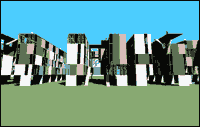
The "LA RAVINE" proposition exemplifies the potentials of any possible assemblage - "RAVINE BLANCHE", "TROPICALITE", etc. It includes XXXX terraces, a combination of all thinkable typologies, a high degree of complexity regarding its interstitial spaces and perspectives, an aggressively affirmed polyfunctionality (there is even the possibility of placing livestock and grazing areas on any floor whatsoever). All of which amounts to a density and a heterogeneity which is not only favourable to the quality of life, but also renders nearly any view of the buildings fragmentary, intricate, and as engaging as it possibly gets.
The most important quality of what is commonly referred to as "public space" isn’t self-professed universal accessibility, but mobility and multivalence.
This is why the tbc is polyfunctional to the point of harbouring even churches should the need arise: any enterprise can be elevated to whatever status or floor is deemed fit, but is submitted to the same predefined formal constraints of any other unit. This makes overbearing monumentalism (religious or otherwise) rather difficult, and also facilitates functional modifications in time. If the demographic explosion really is pending, the latter is perhaps the most important point.
|
 |
|
|
c) regard for the tropical climate
Our proposal admits to a wide array of adaptations and appropriations, including those in view of meteorological factors.
That said, we find it hard to underestimate the importance of problematising our own role as architect-urbanists in this specific context, and of resisting the temptation of hiding behind pseudoscientific meteorological or culturalist considerations.
Sweeping categorisations often harbour implicit hierarchies: the idea of the "Islamic city", for example, describes the influence of (a single type of) "Islam" on the city - but cannot admit to the influence of the city on the lifestyles it harbours.
Tropicality has spawned countless, radically different solutions. The trap in the concept of "Tropical Architecture" is that of using the climate as a pretext for imposing a quasiscientific typology that may have actually been something quite different altogether. (Coming to think of it: Is Parisian architecture classified according to temperature and humidity? As "Moderate-Climate Architecture", perhaps?)
Judging modernities outside the West by way of our age-old, habitual criteria is becoming more and more difficult, now that urbanisation is taking place in far greater proportions out there (in tropical, Muslim, or communist territory) rather than back home. If the norms, and the dynamics that define them, really are changing in the above way, then the metropolis has at least as much to learn from its dom as vice versa.
The following are possible reformulations of the three variables discussed so far - not in the idea of replacing them, but of rearranging their intrinsic priorities:
_ How to draw attention to the medium rather than the product, to the institutions and market mechanisms that define the rules of this game, rather than offer a solution that fits seamlessly and naturally into the given site?
_ How to account for the emerging urban condition specific to the Ravine Blanche without resorting to jungle imagery or pathologising its inhabitants with metropolitan banlieue clichés?
_ How to ensure that the architectural model introduced in the Ravine Blanche be a model in no more than ensuring both financial independence and flexibility through time?
d) facilitating homeownership
A number of screens, sheets, boards and panes will offer perfect spaces for high-quality advertising. This would grant the tbc a substantial degree of economic independence from the state apparatus.
We’re aware of the political connotations of advertising. One striking aspect of the process of globalisation is a newfound nostalgia for a public space that actually barely existed in the first place. The presence of the State in everyday life in the dom might be perceived as liberatory by some, as a sequel to plantation ownership, by others.
In a sense, the advertising would be publicity for the tbc itself. On the one hand, the church, say, or newspaper on the fourth floor could make itself known very easily with the screens at its disposal. On the other, a spectacular Citroën or Air France ad would mainly attract attention to the actual edifice(s): the oft mentioned vocation touristique et balnéaire can so be taken into consideration, since the prettiest beach hut, the best restaurant, and even the hippest discothèque would have a hard time competing with a tbc locality.
One interesting aspect is that "Identity" and "Coherence" are visible only from above. If the "writing" can be seen from a plane, or the hilltop, or sold as a commodified local-identity gimmick, it gains an entirely different lisibility from the everyday ground on which the quartier residents live their lives.
In short, this complex imbrication of self-help, minimised architectural blueprints, and controlled commercialisation might well encourage a public debate on the new roles of architects and the State as actors in what is now, for better or for worse, a mass-media and mobile consumer society.
|

|
|
|










)